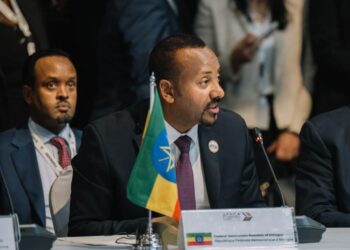











ADDIS ABABA (AEA) — Ethiopia used the grand platform of the BRICS Foreign Ministers meeting in New Delhi on Friday to issue a forceful call for a sweeping structural overhaul of global governance, demanding that international financial and political institutions adjust to reflect modern economic realities.
The high-level Ethiopian delegation, representing one of the newest members of the expanded BRICS bloc, delivered a comprehensive policy statement asserting that the current international order lacks legitimacy, equity, and representation for developing and low-income nations.
The diplomatic push comes as Ethiopia simultaneously navigates crucial domestic changes. On Friday, the Ethiopian National Dialogue Commission (ENDC) presented a comprehensive implementation report to Prime Minister Abiy Ahmed and federal lawmakers in Addis Ababa.
The report indicated that the country’s multi-year nationwide reconciliation process has officially entered its final, critical phase, setting the stage for a formal national consultative conference aimed at resolving deep-seated ethnic and political fractures.
On the international stage, however, Ethiopia’s focus was strictly structural. The delegation centered its arguments on three core pillars of global reform: the United Nations Security Council, the international financial architecture, and the World Trade Organization (WTO) accession processes.
“The architecture governing our world was designed in an era when Africa was largely unrepresented,” the Ethiopian statement read. “On UN Security Council reform, Ethiopia stands firmly with the African common position as enshrined in the Ezulwini Consensus and Sirte Declaration.
The modality of Africa’s representation must be determined solely by the continent itself.”
Turning to financial institutions like the International Monetary Fund (IMF) and the World Bank, Ethiopia demanded that voting shares and institutional representation be realigned based on countries’ relative positions in the modern global economy.
Beyond mere quota adjustments, the delegation stressed the critical need for a fair economic system, explicitly calling for the urgent overhaul of global debt-restructuring mechanisms.
Ethiopia’s focus on debt mechanisms is intensely practical. Like many African nations, Addis Ababa has faced severe fiscal constraints, balancing heavy external debt obligations against the urgent need to fund domestic infrastructure and social programs.
The delegation argued that existing frameworks, such as the G20 Common Framework, remain slow and inefficient, often penalizing developing economies rather than facilitating relief.
Regarding trade, the delegation noted that Ethiopia is actively negotiating its accession to the WTO. It urged the international community to reform the accession process to better accommodate the structural vulnerabilities of developing states.
Furthermore, the delegation warned against the implementation of protectionist trade restrictions disguised as environmental policies, which disproportionately target Least Developed Countries (LDCs).
The dual tracks of domestic reconciliation and aggressive global diplomacy reflect Ethiopia’s broader strategy to restore its status as a stable, influential regional hegemon.
Prime Minister Abiy Ahmed praised the ENDC’s domestic progress, stating that the upcoming reconciliation conference would provide a vital foundation for institutional learning and long-term stability. Together, Ethiopia’s domestic consolidation and active BRICS alignment signal its desire to play a leading role in shaping a multipolar global order.